How We Build
How we build a roof system
None of these are upgrades. None are add-ons. This is the baseline on every roof we build. The things we do aren't for the day of install. They're for year 10 and year 20. Any quote that leaves one out is quoting another roof. Each standard below has its reason, and the source where there is one.
Does a nail gun void a shingle warranty?
No, not by itself. A shingle warranty cares where each nail lands and how deep it goes, not what drove it. A nail driven too deep cuts the shingle mat, and that can void the manufacturer's warranty. We hand-nail every shingle through the common bond so we control the placement and depth of every nail.
The nailing rules for your roof are in the shingle's printed installation instructions. A home inspector explains what over-driven nails do to a shingle and its warranty.
Book my Roof Health Inspection Call (832) 356-4876
A good sales pitch doesn't protect your home. A proven process does. Ask anyone bidding your roof how they handle each item on this page. Breakwater made mistakes, fixed every one, and changed how we build. Doing the same thing and expecting a new result is insanity.
Standard, not upgrades. The full Breakwater Standard goes on every roof, every option. Every price is in writing up front. Anything hidden is photographed and approved by you first. Your roof, your photos. Nothing hidden. Nothing guessed.
Hand nailed vs nail gun shingles: which is better?
Both can meet the installation instructions when every nail lands right. The difference is control. A nail gun doesn't feel the deck. It doesn't know whether the nail landed through the common bond of the shingle. If the nail misses the common bond, the roof system fails. Hand-nailing costs little extra compared to a gun. We do it because it's the stronger system.
Hand-nailing gives us four things: the nail goes in the common bond, it goes in at the right depth without cracking the mat, it holds against wind, and the job site is quieter. Every shingle on every roof we build is hand-nailed.
Why do shingle nails have to go through the common bond?
The common bond is the strip where two layers of the shingle overlap. A nail through it holds both layers. A nail outside it holds one. We put six nails in every shingle, by hand, all in the common bond.
The building code sets the floor. The 2021 International Residential Code calls for at least four fasteners per strip shingle, or more where the manufacturer's instructions ask for more (R905.2.6), using roofing nails with at least a 12-gauge shank and a 3/8-inch head, driven at least 3/4 inch into the deck (R905.2.5). Read the code text.
Is a nail in the nail zone the same as a nail in the common bond?
No. A nail can land inside the manufacturer's nail zone and still miss the common bond, and then it holds one layer, not two. The zone is the target area. The common bond is what makes the nail hold. That is why we hand-nail and check where each nail lands.
This is the difference between the two sections above. A nail gun is aimed at the zone and doesn't know whether the nail reached the common bond. Hand-nailing lets us see and feel every nail, so each one holds both layers.
The printed instructions say the same thing. On steep slopes, one shingle maker puts the fasteners 6 1/8 inches above the butt edge, whether they land in its marked fastening area or in the plain granules, "to secure both layers of the shingle." Another labels the nail line and the common bond separately on its nailing diagram, says to use the nail line as the guide, and warns that nailing high above it can void its limited warranty.
Read the printed instructions yourself: shingle installation instructions from one maker, a second maker's shingle installation instructions and a third maker's shingle installation instructions.
Do you use screws to hold the shingles?
No. Shingles are hand-nailed. Screws with rubber (EPDM) washers go on the exposed flashings, the metal where the roof meets walls, pipes and vents. Nails are a friction fit. As the house shifts and settles, they back out, and water follows the gap. A screw's threads grip and the washer seals the hole. No caulk. No band-aid.
That's the same fix we make on roofs we keep, not replace. How nails in flashings fail and what we do about it.
Does the shingle brand matter?
Shingles are not all built the same, which is why we offer Standard, Class 3 and Class 4. But a warranty is only as good as the install. A shingle's extended manufacturer warranty depends on installing it per the printed instructions with the manufacturer's required components. Leave one out or install it wrong and the warranty can be denied.
Shingles vary in how much asphalt they carry, how they're built and whether the nail strip is reinforced, and the impact class changes what the shingle can take. None of that holds up if the install is wrong. One maker's instructions say the installation instructions must be followed "to qualify for warranty protection." Another says it won't be responsible for problems from any deviation from them.
The warranty documents say it too. In the ones we read from three makers, coverage is for manufacturing defects, and each excludes damage from an install that doesn't follow the printed instructions. The higher wind ratings and lifetime coverage depend on the maker's starter shingles at the eaves and rakes and matching hip and ridge shingles. One maker's bulletin says scrap laminate cut up as ridge cap, or three-tab shingles cut up as starter, don't meet the requirements of its lifetime system. Two of them cut the warranty to 10 years on a roof that isn't ventilated properly. The rules for your shingle are printed in its instructions and warranty, so ask to see both before you sign.
We put every nail through the common bond on every roof, for the strongest hold and wind resistance, whatever shingle goes on. The roof is only as strong as the weakest part of the system.
Why use 2x4 drip edge instead of 2x2?
Code calls for drip edge to reach back onto the deck at least 2 inches (IRC R905.2.8.5). The fascia goes on first, and there's a gap between the fascia and the decking. The fascia doesn't count toward the 2 inches. Once the fascia is on, a 2x2 often doesn't reach. A 2x4 does, and the longer leg protects the fascia.
The old drip edge comes off on every replacement. The old starter row is nailed through it, so new edge metal laid over the old one never sits right.
Do my gutters have to come off for a new roof?
Only when the install needs it. When gutters are fastened through the old drip edge, the old drip edge can't come out with them up, so we detach the gutters and reset them once the new drip edge is on. If they were hung right and the old drip edge comes out without moving them, they stay up and we protect them with Breakwater Gutter Guard.
Hung right means the gutter apron goes straight up under the drip edge and the hangers are fastened below it. Gutters fastened through the drip edge are installer workmanship: water runs behind the drip edge onto the fascia, and the fascia rots slowly, where you can't see it. If you're replacing fascia or soffit, the gutters come down either way.
Why do builders get attic ventilation wrong?
The common mistakes are mixed exhaust, like a ridge vent and box vents on the same roof, and not enough ventilation for the attic. Mixed exhaust short-circuits the airflow: the high vents pull air from the low vents instead of from the eaves. A hot attic cooks the shingles from underneath and makes your AC work harder.
We calculate ventilation for every attic, sized by the attic, not the roof. Intake and exhaust are balanced, exhaust sits at the high points and there is one exhaust type, never mixed. Separate attic spaces, like a garage or a bonus room, each get their own exhaust path.
Can a roof have a ridge vent and other exhaust vents on the same attic?
We don't mix them. A ridge vent can be the right answer on one roof and the wrong one on another, so it comes from the numbers for that attic. A ridge vent combined with other exhaust vents above the same attic short-circuits the airflow. Air takes the shortest path between the two exhausts, the lower attic and the deck sit under-ventilated, and one exhaust can end up pulling air in instead of pushing it out. Putting back the vents that were there repeats the fault, which is why we calculate ventilation for each attic before we build.
Further reading: Roofing Magazine, Do Not Mix Attic Exhaust Vents. The author works for a vent manufacturer, and the piece points to the shingle makers' trade association technical bulletin and to the building code's instruction to install vents per the manufacturer's instructions.
Why does every bath fan and the dryer get its own vent?
Bath fans tied into one cap push steam into the attic, and mold grows where you can't see it. Each fan gets its own vent, its own path and its own cap. It takes longer. It's how it's supposed to be done. The dryer gets a cap made for dryers. Pull a standard roof cap and the base often reads "Not for dryer vent use."
Bathroom fans exhaust through the roof, properly, each on its own path. They are never hidden under a 4-way cap. A 4-way cap can cover a bathroom exhaust that was installed improperly, and we never use one.
The industry standard is a minimum. We build above it.
Code sets the least a roof can have, and the industry standard is built around that line. In places it falls short of it. A 2x2 drip edge can cover less than the 2 inches of deck the code asks for, so we use 2x4. Many dryer vents on roofs here end in a plastic cap stamped "Not for dryer vent use," so we use a cap made for dryers. Bath fans get tied into one vent, so we give every fan its own.
We don't say it to knock anyone. We say it because you should be able to ask any estimate how it handles each of these, and know what the answer should be. That is why we publish the Breakwater Standard, item by item, with the reason for each.
Roofing gets sold on a pitch. We'd rather it got built on a process, by people who know how a roof is built.
Book my Roof Health Inspection
Why We Build This Way
Each of these started as a mistake on a job. Each one is now a rule on every job.
Will roofers ruin my grass, bushes, windows or AC unit?
Not on our jobs. The day before tear-off we put up The Breakwater Seawall: breathable netting over the grass, frames over your bushes, and covers on windows, siding and AC units. Falling debris lands on the netting, not on your property, and nothing sits on your lawn long enough to burn it.
We learned: Plastic tarps burn grass, and falling debris breaks windows, dents AC units and crushes landscaping. So now: The Breakwater Seawall: breathable netting, frames over bushes, windows, siding and AC covered, all up the day before.
How do I know every crew builds my roof the same way?
Every crew builds to the written Breakwater Standard. It lists what goes on every roof and why, so your roof does not depend on which crew shows up or what one person remembers. If a step is on the Standard, it is on your roof. You can read the whole list on this page.
We learned: Without a written standard, every crew builds its own way. So now: Every crew builds to the written Breakwater Standard.
How can I tell if my new roof was installed right?
A roof can look finished and still be built wrong, because the mistakes sit under the shingles. That is why a Breakwater project manager is on the roof while the work happens, checking it as it goes, so a problem gets fixed while it is still open and not buried under the finished roof.
We learned: A roof can look finished and still be built wrong. So now: A project manager is on the roof, checking the work as it goes.
Will roofers damage my gutters?
They can, if the gutters stay up. Gutters left in place get bent, cracked or pulled loose during a tear-off. On our jobs they are detached and reset, or protected with Breakwater Gutter Guard, so the gutters you had when we started are the gutters you still have when we leave.
We learned: Gutters left up get bent, cracked and pulled loose. So now: Gutters are detached and reset, or protected with Breakwater Gutter Guard.
Will there be nails in my driveway after a new roof?
Not if the sweeps are done right. One missed nail can flatten a tire or hurt a child or a pet. We run a magnet over the property at three points: after tear-off, during the build and at the end. The goal is simple. You never find one of ours.
We learned: One missed nail can flatten a tire or hurt a child or pet. So now: Magnet sweeps after tear-off, during the build and at the end.
Why do shingles blow off a new roof?
One cause is crooked, gun-driven nails. A nail that goes in off-angle or at the wrong depth does not hold, and the next storm lifts the shingle. We hand-nail every roof with six nails in the common bond, so every nail goes where it should and holds both layers.
We learned: Crooked gun-driven nails let shingles blow off in the next storm. So now: Hand-nailed, six nails in the common bond.
Why does my roof leak at the flashing years later?
Exposed nails back out. The house moves, the nail works loose, and water follows the gap, often years after the roof went on. On our roofs every exposed flashing is fastened with a screw and a sealing rubber (EPDM) washer, so the fastener grips and the hole stays sealed.
We learned: Exposed nails back out and leak, often years later. So now: Exposed flashings get screws with sealing (EPDM) washers.
Can my bathroom fans cause mold in the attic?
Yes. Fans tied into one vent push steam into the attic, and mold grows where you cannot see it. On every Breakwater roof each bath fan gets its own exhaust vent, so the steam leaves the house instead of settling in the attic. We correct it on every roof, never leave it as found.
We learned: Fans tied into one vent push steam into the attic, and mold grows where you can't see it. So now: Every bath fan gets its own exhaust vent.
Why is my attic so hot and my upstairs AC always running?
Poor attic ventilation is a likely cause. A hot attic cooks the shingles from underneath and makes the AC work harder to cool the rooms below. We calculate ventilation for every attic and use one exhaust type, never mixed, so air moves through the attic the way it was designed to.
We learned: Poor ventilation cooks shingles from below and overworks the attic AC. So now: Ventilation calculated for every attic, one exhaust type, never mixed.
Should a roofer reuse my pipe boots and vents?
No. Old pipe boots and vents fail long before a new roof does, so reusing them puts a leak under a new roof. On our jobs nothing is reused: every pipe boot, B-vent flashing and roof vent is new, so the parts that fail first start fresh along with the shingles.
We learned: Old boots and vents fail long before a new roof does. So now: Nothing reused. Every boot, B-vent flashing and vent is new.
Will I get hit with surprise charges halfway through?
Not from us. Every price is in writing before work starts. If we find something hidden once the roof is off, we photograph it, price it in writing and get your approval before any work begins. Nothing extra happens without your approval and the documentation to back it up.
We learned: Surprise charges cost trust. So now: Every price in writing. Nothing extra without your approval and documentation.
The Breakwater Standard
A roof is built as a complete system, deck to ridge, by professionals who take pride in the craft. Here is every item and why it is there.
Tear-off to the deck, never a layover
Every layer comes off so we can see what the roof sits on. The whole deck is inspected and loose decking is re-fastened. Rot is replaced, never covered. Every bad sheet is photographed and approved by you first, at a per-sheet price stated up front. Radiant-barrier decking is matched with radiant-barrier sheets.
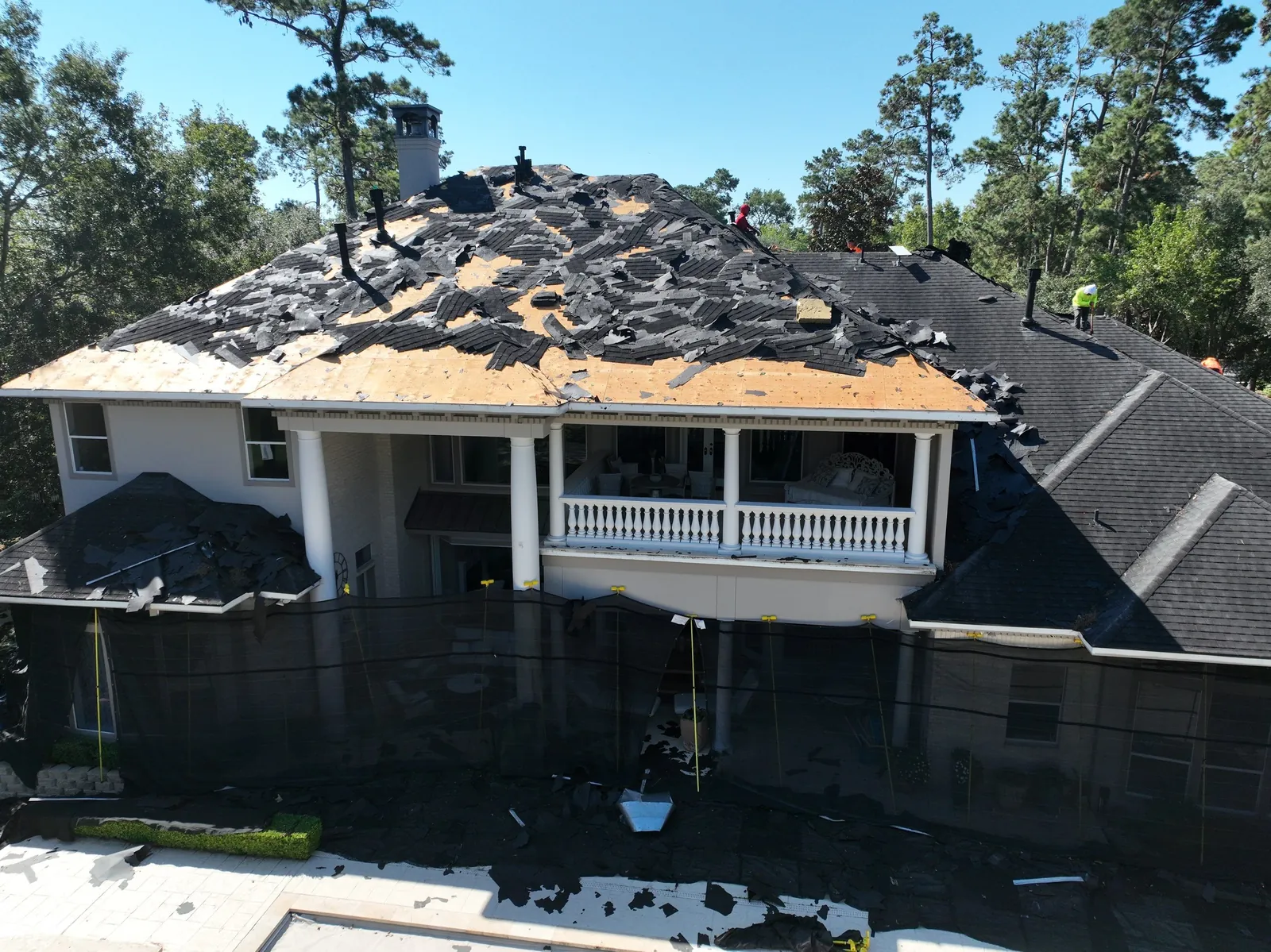
Tear-off down to the deck, with netting up on the walls. [PHOTO: swap — stand-in photo; swap for a Breakwater job when one exists] 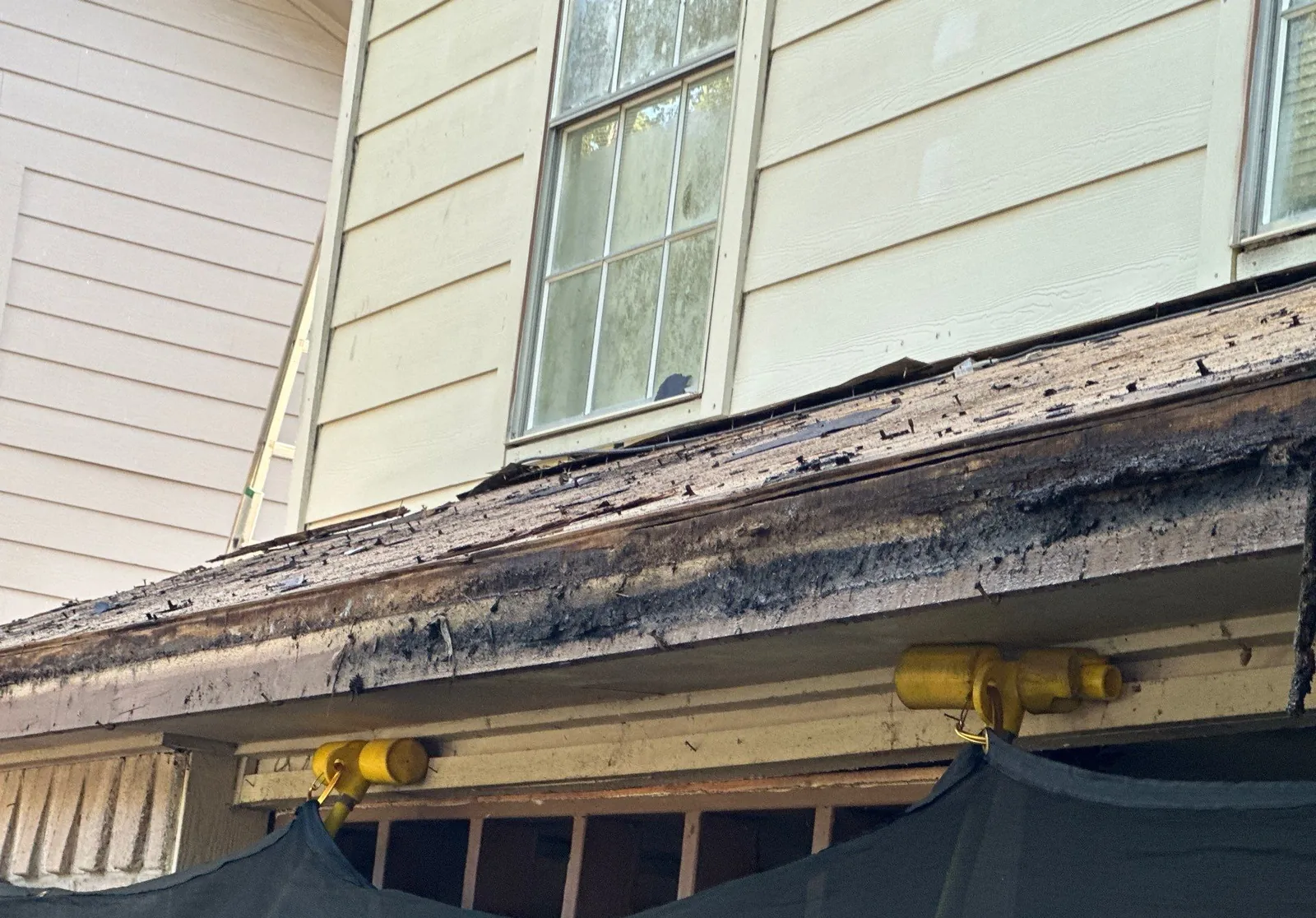
Rotted deck at the eave, found at tear-off. It gets fixed and itemized, with photos. [PHOTO: swap — stand-in photo; swap for a Breakwater job when one exists] 2x4 drip edge, every time
Drip edge must cover at least 2 inches of the deck. A 2x2 can fall short and leave the deck edge to rot. The 4-inch leg covers past the minimum and protects the fascia. It is painted.
[BRIAN: #60 confirm the absolute wording / VERIFY the code number before this line ships]Synthetic underlayment over the whole deck
It is the backup layer if wind-driven rain gets past the shingles.
Ice & water membrane in every valley and around every pipe and vent
These are the places water gets in. The membrane seals around the nails driven through it. No valley metal.
Starter at every eave and rake
The sealant strip locks the first row so wind cannot lift the edge, and it fills the gaps under shingle joints. Shingle makers require their own starter and hip & ridge for their top wind warranties.
Six nails, by hand, in the common bond
The common bond is where both layers overlap, so every nail holds both. Nails are sized to manufacturer requirements: 12-gauge, 3/8-inch head, 3/4 inch into the deck. A nail gun doesn't feel the deck. Over-driven nails crack the mat; under-driven nails sit proud and lift in the wind.
[BRIAN: #24 confirm the absolute wording / VERIFY the code number before this line ships]Hip & ridge caps matched to the shingle
Bent over the peak and hand-nailed as their own step, not rushed at the end of the shingle run.
Step flashing woven in with every course
At every side wall, so water runs over the shingles, not behind them.
Nothing reused
A new 3-in-1 pipe boot on every pipe (adjustable collar) with ice & water membrane behind it, new B-vent flashing and new roof vents. A known 10 to 12 year failure point doesn't go back on a new roof.
Screws with rubber (EPDM) washers on every exposed flashing
Nails back out as the house moves. The screw threads grip and the washer seals the hole. No caulk. No band-aid. Exposed metal is touched up with paint so it doesn't rust or stand out.
[BRIAN: #20 confirm the absolute wording / VERIFY the code number before this line ships]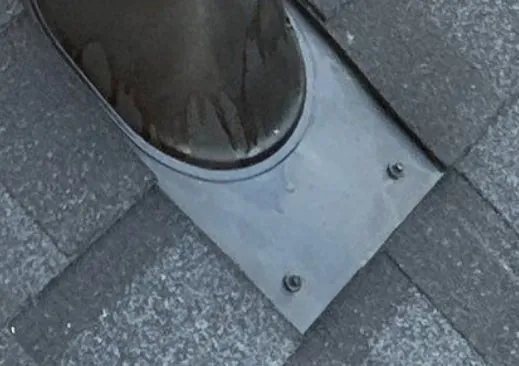
Flashing flange held down with screws and rubber washers. No caulk. [PHOTO: swap — stand-in photo; swap for a Breakwater job when one exists] Dryer vented through a cap made for dryers
Dryer exhaust carries heat, lint and moisture. Many caps on roofs here are stamped "Not for dryer vent use" on the base. The cap we use is made for dryers: a curved damper, no screen for lint to clog and a cleanout panel.
Kitchen exhaust through its own roof cap
It leaves through its own cap, never into the attic.
Every bath fan vented on its own
Each fan gets its own low-profile vent, so steam leaves instead of causing mold. We correct this on every roof, never leave it as found.
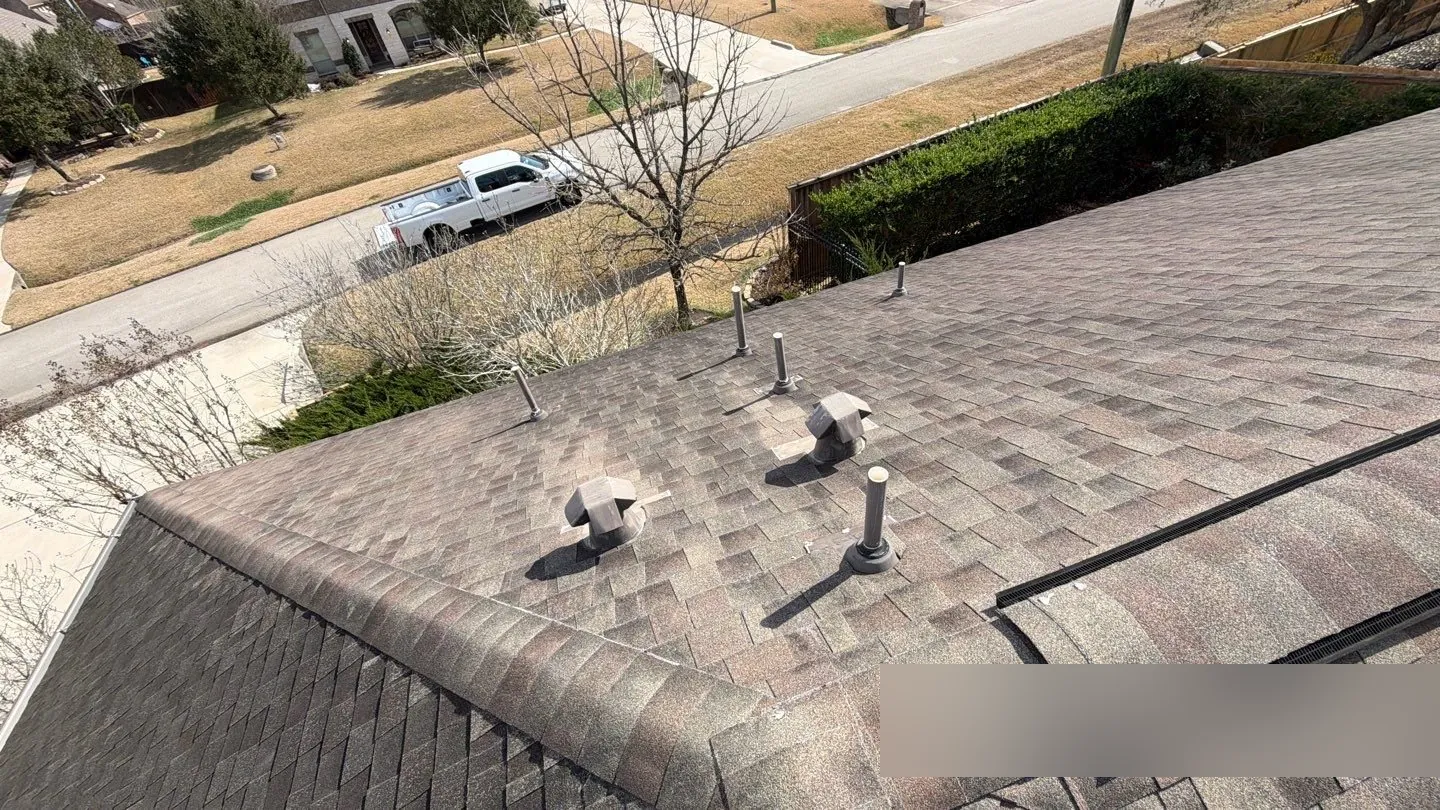
Two 4-way exhaust caps on a shingle roof. [PHOTO: swap — stand-in photo; swap for a Breakwater job when one exists] 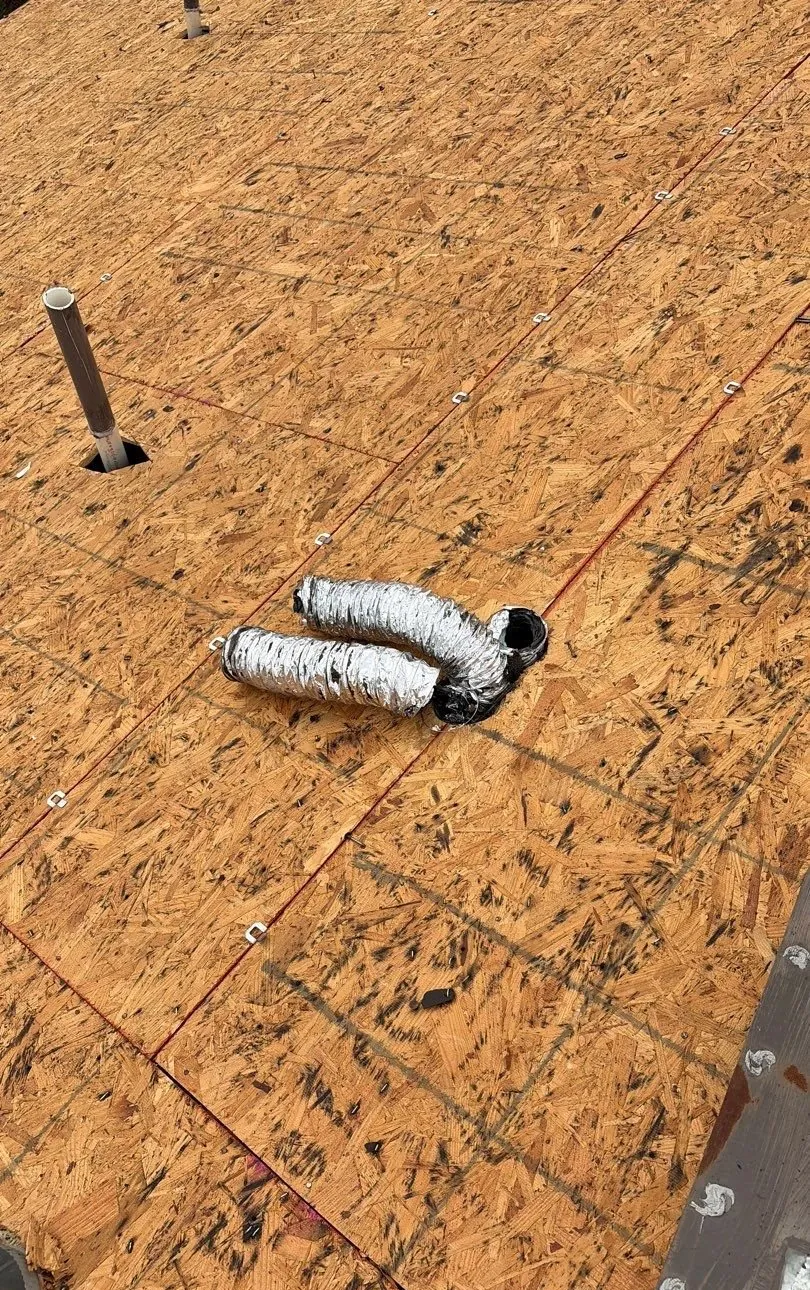
Under a 4-way cap after tear-off: two fan ducts sharing one hole. [PHOTO: swap — stand-in photo; swap for a Breakwater job when one exists] 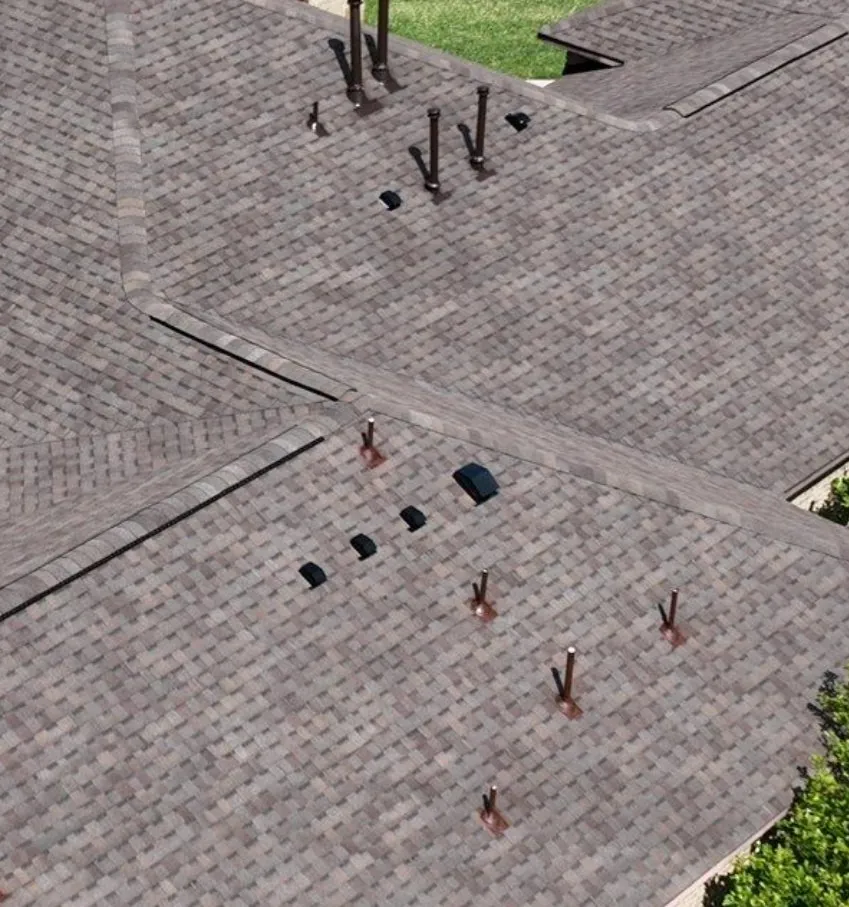
Separate vent, separate path, separate cap. [PHOTO: swap — stand-in photo; swap for a Breakwater job when one exists] Ventilation calculated for your attic
Sized by the attic, balanced intake and exhaust with exhaust at the high points, one exhaust type and never mixed (for example, dome vents when that is the attic's type). Optional boost: a solar attic fan that runs on thermostat and humidity control at no electric cost.
[BRIAN: #62 confirm the absolute wording / VERIFY the code number before this line ships]Dried in the same day it is torn off
A tarp plan is ready for weather before the first shingle comes off.
Also on every roof
Gutters detached and reset when they're fastened through the drip edge
On most homes here they are. The new drip edge has to go on correctly, and water shouldn't run behind it into the fascia.
[BRIAN: #19 confirm the absolute wording / VERIFY the code number before this line ships]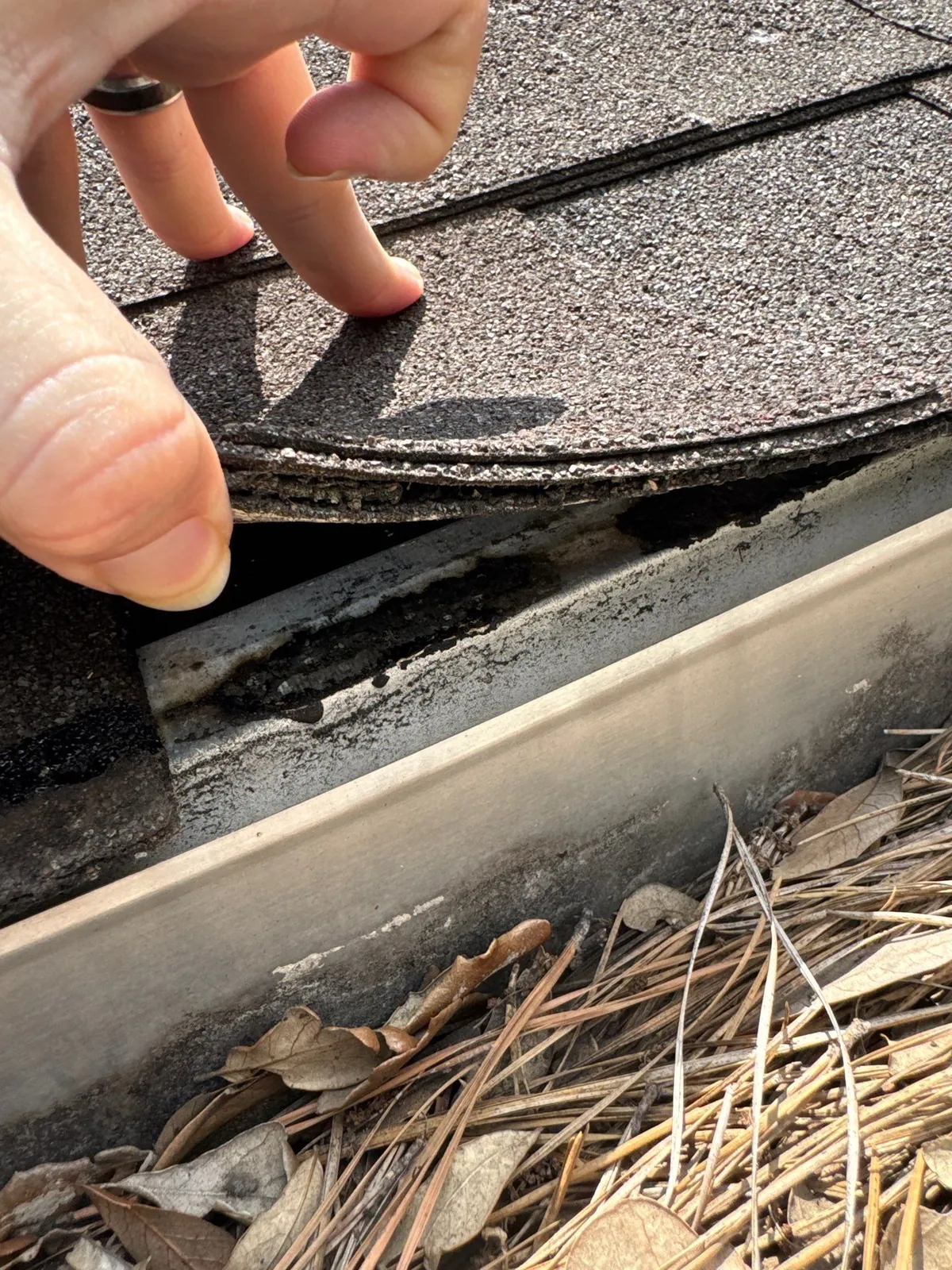
Shingle edge lifted at the gutter. The gutter is packed tight against the roof edge. [PHOTO: swap — stand-in photo; swap for a Breakwater job when one exists] The Breakwater Seawall
Perimeter netting and breathable ground tarps set the day before tear-off; several magnet sweeps after.
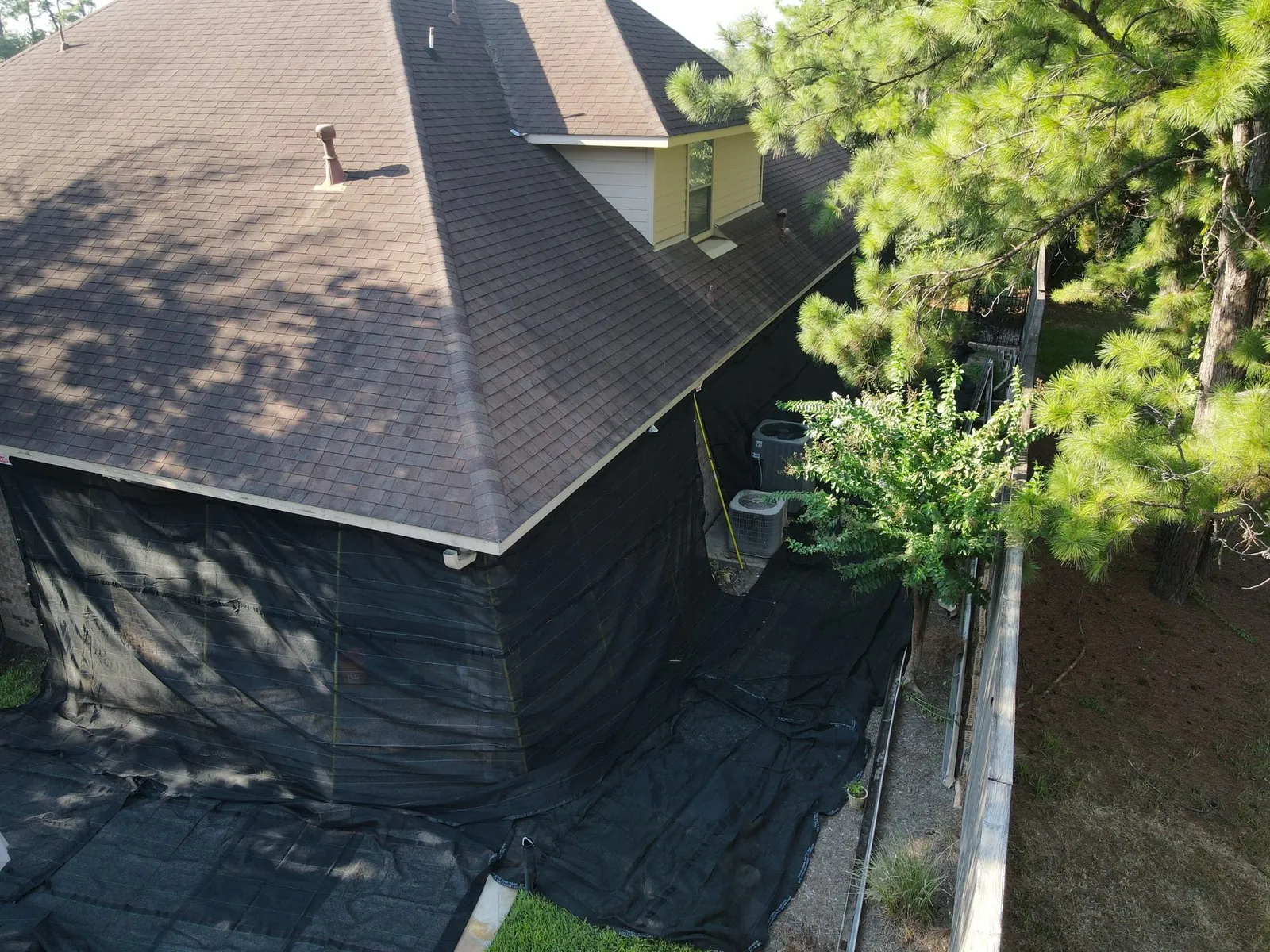
The AC units sit inside the netting. [PHOTO: swap — stand-in photo; swap for a Breakwater job when one exists] Magnetic nail sweep of the whole property, photographed
Your yard does not pay for your new roof.
Dormer flat metal caps new, not painted over
A photo record: before, during, after
Time-stamped. The record is yours for good.

The roof from the air, before any work. The record starts here. [PHOTO: swap — stand-in photo; swap for a Breakwater job when one exists] Manufacturer warranty filed in your name
Most homeowners assume it's automatic. It isn't. An unfiled warranty is an uncovered roof.
Every standard above is on every roof. Ask any other estimate if these are included.
We used to build the other way
Over the years we learned. We used to use 2x2 drip edge. Then we learned it doesn't cover the decking once the fascia is on. So we changed. Every time we found a more correct way, we changed the standard. Not for some jobs. For every job.
What should I ask anyone bidding my roof?
Ask these on every estimate, ours included. The answers tell you what roof you're being quoted.
- Are the shingles hand-nailed, and do the nails go through the common bond?
- What fastens the exposed flashings: nails, or screws with rubber washers?
- What size drip edge, and does it reach 2 inches onto the deck once the fascia is on?
- Are my gutters fastened through the drip edge, and what happens to them during the job?
- How is my attic ventilation figured, and will any exhaust types be mixed?
- Does every bath fan get its own vent, and is the dryer cap made for dryers?
- Are the pipe boots, vents and flashings new, or reused?
What happens when I book a Roof Health Inspection?
We call to confirm the time and who's coming. The visit is about an hour. We go over the roof, the attic and the roofline, and you get a forensic photo report of your own roof. Then we walk you through what we found and what your options are.
Every standard on this page goes into every roof replacement we build, and the workmanship is backed by our lifetime workmanship warranty. We build roofs across Conroe and the rest of our service area. Questions? Call (832) 356-4876 or email [email protected].
Questions homeowners ask
Does a nail gun void a shingle warranty?
No, not by itself. A shingle warranty cares where each nail lands and how deep it goes, not what drove it. A nail driven too deep cuts the shingle mat, and that can void the manufacturer's warranty. We hand-nail every shingle through the common bond so we control the placement and depth of every nail.
Hand nailed vs nail gun shingles: which is better?
Both can meet the installation instructions when every nail lands right. The difference is control. A nail gun doesn't feel the deck, and it doesn't know whether the nail landed in the common bond. Hand-nailing costs little extra. We do it on every roof because it's the stronger system.
Why do shingle nails have to go through the common bond?
The common bond is the strip where two layers of the shingle overlap. A nail through it holds both layers. A nail outside it holds one. We put six nails in every shingle, by hand, all in the common bond.
Is a nail in the nail zone the same as a nail in the common bond?
No. A nail can land inside the manufacturer's nail zone and still miss the common bond, and then it holds one layer, not two. The zone is the target area. The common bond is what makes the nail hold. That is why we hand-nail and check where each nail lands.
Does the shingle brand matter?
Shingles are not all built the same, which is why we offer Standard, Class 3 and Class 4. But a warranty is only as good as the install. A shingle's extended manufacturer warranty depends on installing it per the printed instructions with the manufacturer's required components. Leave one out or install it wrong and the warranty can be denied.
Do you use screws to hold the shingles?
No. Shingles are hand-nailed. Screws with rubber (EPDM) washers go on the exposed flashings, the metal where the roof meets walls, pipes and vents. Nails back out as the house shifts and settles. The screw threads grip and the washer seals the hole.
Why does drip edge size matter?
Code calls for drip edge to reach back onto the deck at least 2 inches. The fascia goes on first and doesn't count toward those 2 inches. Once the fascia is on, a 2x2 often doesn't reach. A 2x4 does, so we use 2x4.
Do my gutters have to come off for a new roof?
Only when the install needs it. When gutters are fastened through the old drip edge, the drip edge can't come out with them up, so we detach and reset them. If they were hung right and the old drip edge comes out without moving them, they stay up and we protect them.
Can a roof have a ridge vent and other exhaust vents on the same attic?
We don't mix them. Two kinds of exhaust vent above one attic short-circuit the airflow: air takes the shortest path between the two exhausts, the lower attic and the deck sit under-ventilated, and one exhaust can end up pulling air in instead of pushing it out. A ridge vent can be right on one roof and wrong on another, so we calculate ventilation for each attic.
Why do bathroom fans never go under a 4-way cap?
Bathroom fans exhaust through the roof, each on its own path with its own vent, so the steam leaves the house. A 4-way cap can hide a bathroom exhaust that was installed improperly. We never use one.
Why do builders get attic ventilation wrong?
The common mistakes are mixed exhaust, like a ridge vent and box vents on one roof, and not enough ventilation for the attic. We calculate ventilation for every attic, balance intake and exhaust, and use one exhaust type, never mixed.
Will roofers ruin my grass, bushes, windows or AC unit?
Not on our jobs. The day before tear-off we put up The Breakwater Seawall: breathable netting over the grass, frames over your bushes, and covers on windows, siding and AC units. Falling debris lands on the netting, not on your property, and nothing sits on your lawn long enough to burn it.
How do I know every crew builds my roof the same way?
Every crew builds to the written Breakwater Standard. It lists what goes on every roof and why, so your roof does not depend on which crew shows up or what one person remembers. If a step is on the Standard, it is on your roof. You can read the whole list on this page.
How can I tell if my new roof was installed right?
A roof can look finished and still be built wrong, because the mistakes sit under the shingles. That is why a Breakwater project manager is on the roof while the work happens, checking it as it goes, so a problem gets fixed while it is still open and not buried under the finished roof.
Will roofers damage my gutters?
They can, if the gutters stay up. Gutters left in place get bent, cracked or pulled loose during a tear-off. On our jobs they are detached and reset, or protected with Breakwater Gutter Guard, so the gutters you had when we started are the gutters you still have when we leave.
Will there be nails in my driveway after a new roof?
Not if the sweeps are done right. One missed nail can flatten a tire or hurt a child or a pet. We run a magnet over the property at three points: after tear-off, during the build and at the end. The goal is simple. You never find one of ours.
Why do shingles blow off a new roof?
One cause is crooked, gun-driven nails. A nail that goes in off-angle or at the wrong depth does not hold, and the next storm lifts the shingle. We hand-nail every roof with six nails in the common bond, so every nail goes where it should and holds both layers.
Why does my roof leak at the flashing years later?
Exposed nails back out. The house moves, the nail works loose, and water follows the gap, often years after the roof went on. On our roofs every exposed flashing is fastened with a screw and a sealing rubber (EPDM) washer, so the fastener grips and the hole stays sealed.
Can my bathroom fans cause mold in the attic?
Yes. Fans tied into one vent push steam into the attic, and mold grows where you cannot see it. On every Breakwater roof each bath fan gets its own exhaust vent, so the steam leaves the house instead of settling in the attic. We correct it on every roof, never leave it as found.
Why is my attic so hot and my upstairs AC always running?
Poor attic ventilation is a likely cause. A hot attic cooks the shingles from underneath and makes the AC work harder to cool the rooms below. We calculate ventilation for every attic and use one exhaust type, never mixed, so air moves through the attic the way it was designed to.
Should a roofer reuse my pipe boots and vents?
No. Old pipe boots and vents fail long before a new roof does, so reusing them puts a leak under a new roof. On our jobs nothing is reused: every pipe boot, B-vent flashing and roof vent is new, so the parts that fail first start fresh along with the shingles.
Will I get hit with surprise charges halfway through?
Not from us. Every price is in writing before work starts. If we find something hidden once the roof is off, we photograph it, price it in writing and get your approval before any work begins. Nothing extra happens without your approval and the documentation to back it up.
See what your roof is telling you before you decide anything.
- Book a roof inspection.
- We bring your roof system down to you. The good, the bad, what's failing, in photos.
- You decide.