Storm & hail documentation
Storm damage roof repair and hail documentation
After a storm, get documented before you file. We inspect, photograph and date what the storm did, and what's just age, so you know what's there. We don't argue coverage. We prove necessity. Insurance determines coverage. You own your claim and decide the outcome. We're the roofing contractor, not the claim advocate.
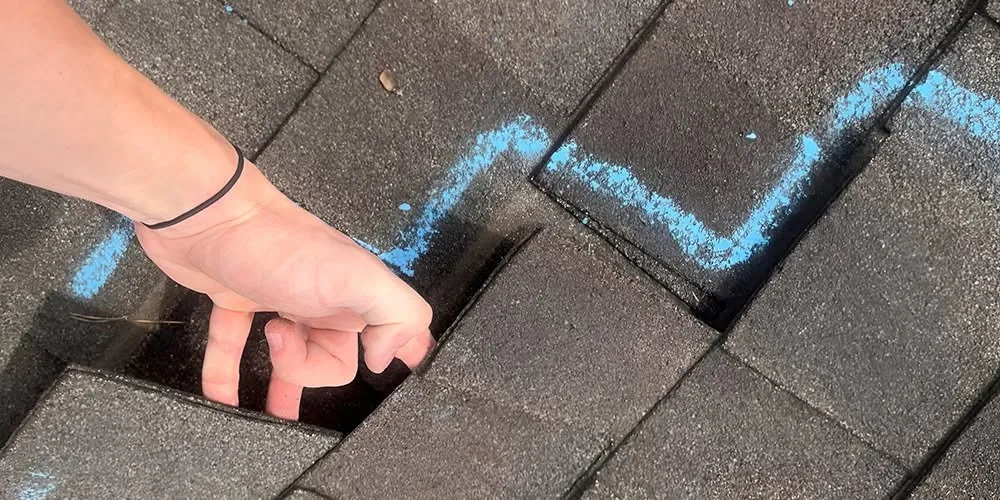
What we do, and what we don't
We document the damage and provide a detailed repair estimate; you and your insurer handle the claim. Our part is the roof: what the storm did, what's just age, and what code and the manufacturer's instructions require to put it back. We don't negotiate with your insurer, and we never pay, waive or absorb a deductible.
Texas doesn't allow a roofer who is doing the work to act as a public adjuster. See the Texas Department of Insurance page, Roofing and insurance: know the law.
It's your policy, your claim, your loss to prove. The carrier runs a process with trained people. You have a phone and an afternoon. We close that gap with evidence: a forensic photo report written by roof-system builders and an estimate built from your roof, in your hands before you file. Doing the same thing over and expecting a new result is the definition of insanity. Denied or approved, the documentation is yours.
Why is it harder to get a roof paid now?
Because the proof now rests on your documentation. Your roof is judged by its age and condition, not only by its damage, and carriers look at roofs from the air before and during a claim. Only evidence from the ground moves either one. That evidence is the forensic photo report: owned by you, built by roof-system builders. Here is what has changed and what in the report answers it.
- Roof payment schedules. Some policies pay a roof by its age, not its cost, and you pay the rest. You answer it with an honest age and condition record, so nothing is argued from a guess.
- Actual cash value instead of replacement cost on older roofs. You are paid depreciated value, not replacement. You answer it with condition evidence and an estimate that shows the true cost to restore the roof, so you know the gap before you file.
- Cosmetic-damage exclusions. Dents, granule loss and bruising get called "cosmetic." You answer it with function evidence: mat fractures, broken seal lines, a repairability test and hit counts per slope.
- Percentage deductibles. A real hail claim can fall under the deductible. You answer it with an honest estimate first, so you decide with the numbers in hand.
- Decking and code items excluded or disputed. Code-required work goes unpaid even when the roof must be rebuilt to code. You answer it with a code and manufacturer requirements section, cited by item.
- The carrier picks the repair. The repair may not meet manufacturer specs, and the warranty on it is the vendor's, not yours. You answer it with a written scope to manufacturer and code, so any proposed repair can be compared to it.
- Aerial and AI roof review. Decisions get made on a roof image, sometimes with no one on the roof. You answer it with ground-level, slope-by-slope photos at far, mid and near distance, captioned, which imagery cannot produce.
- Wear versus storm. Aging roofs get the whole claim attributed to age. You answer it with existing conditions photographed and kept apart from fresh hits, with the weather for the date of loss.
- Documentation requests that repeat. Time passes while the same papers are asked for again. You answer it with one complete, organized file handed over once and owned by you.
The Texas Office of Public Insurance Counsel's own guidance to homeowners is to document everything: photograph or video the damage, keep records of every communication, keep receipts for repairs and out-of-pocket costs. See OPIC, Residential Property Insurance: Claims. We make that documentation hold up.
Does hail damage leak right away?
Usually not. Hail typically won't cause an immediate leak, but it compromises the roof system, and a damaged roof will fail at some point. Most hail damage isn't obvious from the ground. That's why we document it instead of guessing.
Some shingles blew off. Will my roof leak before it's fixed?
It can. Where a shingle is gone, the layer under it is taking the weather the shingle was built to take. Wind damage isn't a mark; it's a missing or creased shingle, and once a shingle lifts, its seal strip doesn't reliably stick back down. If water is coming in now, start with what to do when your roof is leaking and roof repair.
What does a storm inspection look at?
- Every slope, with an overview photo, test areas and close-ups.
- The things hail can't fake: gutters, downspouts, window screens, the AC unit and the fence.
- How the gutters are installed, and the condition of each pipe boot.
- Wear from age and earlier repairs, shown next to the storm damage, so you can see the difference.
- Wind direction, for missing or creased shingles.
You get the photos and a detailed repair estimate built from what the photos show. That documentation belongs to you whether you move forward with us or not.
Book my Roof Health Inspection
What is in a roof damage report that holds up?
Proof on every slope, not a few pictures. Test squares with hit counts, collateral damage, existing conditions kept separate, repairability, code and manufacturer requirements, the weather for your date of loss, and an estimate where every line traces back to a photo.
The forensic photo report holds:
- Slope-by-slope 10x10 test squares with hit counts.
- Collateral damage: gutters, screens, soft metals, AC fins.
- Existing conditions kept separate from storm damage.
- A repairability assessment.
- Ventilation and the attic.
- The four elevations.
- Code and manufacturer requirements.
- A weather report for the date of loss, plus local posts from that day.
- A line-item estimate where every line traces to a photo or finding.
Every condition is shot far, mid and near. Each caption runs location, what, why it matters. You get 8 to 12 key photos, not 300. Anything we couldn't see reads "Unknown at time of inspection," never a guess. We lead with what is good. If it isn't photographed, it didn't happen, and a few phone photos aren't proof.
Who owns the report?
You do, whether you move forward with us or not. The homeowner who owns their documentation owns their claim.
What should I read in my policy before I file?
Before you file, read your declarations page for four things: the roof payment schedule, whether the roof is paid at replacement cost (RCV) or actual cash value (ACV), any cosmetic-damage exclusion, and the deductible type. That is your document and your conversation with your agent. We point you to it. We don't interpret it. We tell you what the roof shows.
Claim questions, answered first
Each answer comes back to one thing: the homeowner faces a trained process alone, and evidence closes that gap. We never close it by attacking the other side.
My claim was denied. Is that the end?
No. A denial is a decision about the file, not about your roof. The damage is still there and the loss is still yours to prove. A few photos sent in on a hope isn't a process. Ours is: a forensic photo report and a full estimate in your hands before you file. Your policy sets the deadlines. Read them.
Why did my insurance deny my roof hail claim?
Look at what the file proved. Showing damage exists is one of four things you have to prove: that the loss occurred, when, how, and that it fell inside your policy period. A few phone photos don't carry that. A forensic photo report built by roof-system builders does.
What proof does my insurance company need?
Four things: the loss occurred, when it occurred, how it happened, and that it happened during your policy period. Your carrier will not build your case for you. That is your job, so build it with someone who knows how.
The adjuster says it's only cosmetic.
"Cosmetic" is a label, not a measurement. Hail bruises the shingle mat, strips granules and breaks seal lines, and each one shortens the life of your roof. We photograph and count the hits slope by slope. Your declarations page shows how your policy treats it.
The adjuster says the damage was already there.
Old roofs have wear, and hail leaves its own signature. We photograph both and keep them apart: existing conditions on one side, fresh storm hits on the other, with the weather for your date of loss attached. Wear doesn't erase hail.
They only want to pay to repair a few shingles.
A roof is a system, not a pile of shingles. Replacing one means lifting the course above it and breaking the factory seal, and most shingles can't be spot-replaced within the manufacturer's conditions. We test it, count hits slope by slope, and put repairability in writing.
The insurance estimate is lower than yours.
We don't match an approved amount, because we don't price from a carrier's paperwork. We price the roof system: every component, to code and manufacturer specs, back to pre-loss condition. Xactimate is a reference, not an enforceable rate. We won't install less than your roof needs.
The insurance company said get three estimates.
Interview three contractors. Find the one with the most value, who aligns with you and not the insurance company, to build your roof system correctly. Three estimates is a cost-control tool: a carrier's goal is the lowest supportable number, and three bids hand it one. Three bids price three roofs that aren't the same roof, and the lowest is usually lowest for what it leaves out.
It isn't about handing a carrier a pile of information. It's about the right information, in the right order. A low bid is shingles off, shingles on. We don't settle for whatever number comes back. We scope the roof system, because we know what it takes to build one.
Do I document first or call my insurance first?
Document first. The biggest mistake after a storm is filing a claim with nothing in your hands. We inspect, you get the forensic photo report and the estimate, then you decide whether to file, in your own name. Check your policy for its notice deadlines.
Why not just call my claim in?
Filing is your right and your decision. Filing with nothing in your hands is the mistake. Calling a claim in and expecting a smooth approval for every component of your roof system no longer works as a plan. Know what your roof needs, hold the proof, then file in your own name.
Does my roof estimate help get my claim approved?
No. Approval turns on proof of the loss, not on the price of your roof. Prove the loss first. Then the estimate matters: ours is written the correct way to build your roof system, every component, so you know what restoring it takes before any carrier number comes back.
How do I prove when the hail hit?
A storm-history table proves opportunity, never damage. Your roof proves the rest: hits on every slope, and on gutters, downspouts, screens and AC fins that can't fake hail damage. One storm, one date of loss, tied to the weather that day.
What should I photograph after a storm?
If it isn't photographed, it didn't happen. Before anything is touched: your pre-storm photos if you have them, a timeline of when you found the damage, and receipts for any temporary repairs. Then call us and we document the rest.
Does it matter who documents my roof?
Yes. A claim is only as strong as the person who can describe the roof system. A contractor trained on shingles can tell you shingles are damaged. A builder shows what code and the manufacturer require, what can't be repaired, and what the whole system needs. That gap is the difference between a few photos and proof.
Why not just put the same roof back?
Because the old roof may have been built wrong, and putting it back the same way builds the same problem again. A real replacement evaluates the system first: ventilation, flashings, edges. Two kinds of exhaust vent on one attic, for example, short-circuit the airflow and leave the lower attic unventilated. We correct what the roof needs instead of rebuilding what was there.
More on this at Roof Replacement and How We Build.
How do I know a roofer really builds a good roof?
Every roofer claims the top spot. Ask: by whose standard? Ask where it is written, in code and the manufacturer's instructions, and ask to see it on a roof they built: ventilation calculated, bathroom fans exhausted properly through the roof instead of hidden under a 4-way cap, flashings fastened to last. A real standard shows up in the details you can check.
Do insurance companies really deny and delay claims?
It's documented. Rutgers law professor Jay Feinman's book Delay, Deny, Defend lays out how major insurers reworked claims handling in the 1990s to treat claims as a cost to control. Homeowners meet the result every day: files that sit, the same documents requested twice. So we build your file complete the first time.
Source: Delay, Deny, Defend: Why Insurance Companies Don't Pay Claims and What You Can Do About It, by Jay Feinman.
Can my roofer talk to my insurance about my policy?
No. Coverage and exclusions are between you and your carrier. A roofer can give estimates and talk about the damage and what it costs to replace. Negotiating a claim or advocating for you is another job, and it is not ours. We give you the documentation, the proof and the estimate so you can speak for your own claim.
Can my roofer deal with the adjuster?
We can discuss the construction, the damage and our estimate with your adjuster. We can't negotiate your claim, argue it for you or talk coverage. That's your policy and your claim. We've already handed you everything needed to prove your loss, and we answer construction, code and method questions anytime.
What is a supplement?
Supplements are what we are getting away from. The full estimate goes in up front, built from your roof and not from a carrier's number. The one exception is a condition nobody could see until the roof came off. We photograph it first and price it as a change order.
Do I have to pay my insurance deductible?
Yes. Texas Insurance Code Chapter 707 requires you to pay it, and Business and Commerce Code §27.02 makes it illegal for a contractor to offer to waive, rebate or absorb it. Your deductible is the same no matter who you hire. We document the damage and provide a detailed repair estimate; you and your insurer handle the claim. Source: Texas Department of Insurance.
Does a Class 4 roof lower my insurance?
It can, but your insurance company decides, not us. Ask your agent whether they give a premium discount for Class 4 impact-rated roofs, and what paperwork they need. We will give you the rating and the install records you need for that conversation, once the roof is on.
Roof options and what each includes are on Roof Replacement.
Storms in your area
We document storm damage across Conroe, The Woodlands, Spring and Montgomery County.
Questions homeowners ask
How do I know if my roof has hail damage if I can't see anything from the ground?
You usually can't tell from the ground. Hail bruises shingles and dents soft metals on the roof. A documented inspection with test areas and close-up photos shows what the storm did, and what's just age. We photograph the good areas too, so the record is honest.
Should I file a claim for hail damage on my roof?
That's your decision, and it's your claim. Get documented first so you know what's there. If we don't find storm damage, we tell you that. Check your policy for its reporting deadline. We document the damage and provide a detailed repair estimate; you and your insurer handle the claim.
Can a roofer pay my deductible for me in Texas?
No. A Texas contractor cannot pay, waive, rebate or absorb your deductible. See Texas Insurance Code Chapter 707 and Business and Commerce Code §27.02.
Can you handle my claim for me?
No. In Texas, a roofer who does the work can't act as your adjuster, file your claim or negotiate it. We document the damage and provide a detailed repair estimate; you and your insurer handle the claim. We're glad to answer construction, code and manufacturer questions.
Shingles blew off my roof in the wind. Will insurance pay for that?
Your policy decides coverage, not your roofer. What we can do is document what came off, when, and what the roof needs to be put back to code and manufacturer requirements.
Does a Class 4 roof lower my insurance?
It can, but your insurance company decides, not us. Ask your agent whether they give a premium discount for Class 4 impact-rated roofs, and what paperwork they need. We will give you the rating and the install records you need for that conversation, once the roof is on.
Do I have to pay my insurance deductible?
Yes. Texas Insurance Code Chapter 707 requires you to pay it, and Business and Commerce Code §27.02 makes it illegal for a contractor to offer to waive, rebate or absorb it. Your deductible is the same no matter who you hire. We document the damage and provide a detailed repair estimate; you and your insurer handle the claim.
See what your roof is telling you before you decide anything.
- Book a roof inspection.
- We bring your roof system down to you. The good, the bad, what's failing, in photos.
- You decide.